
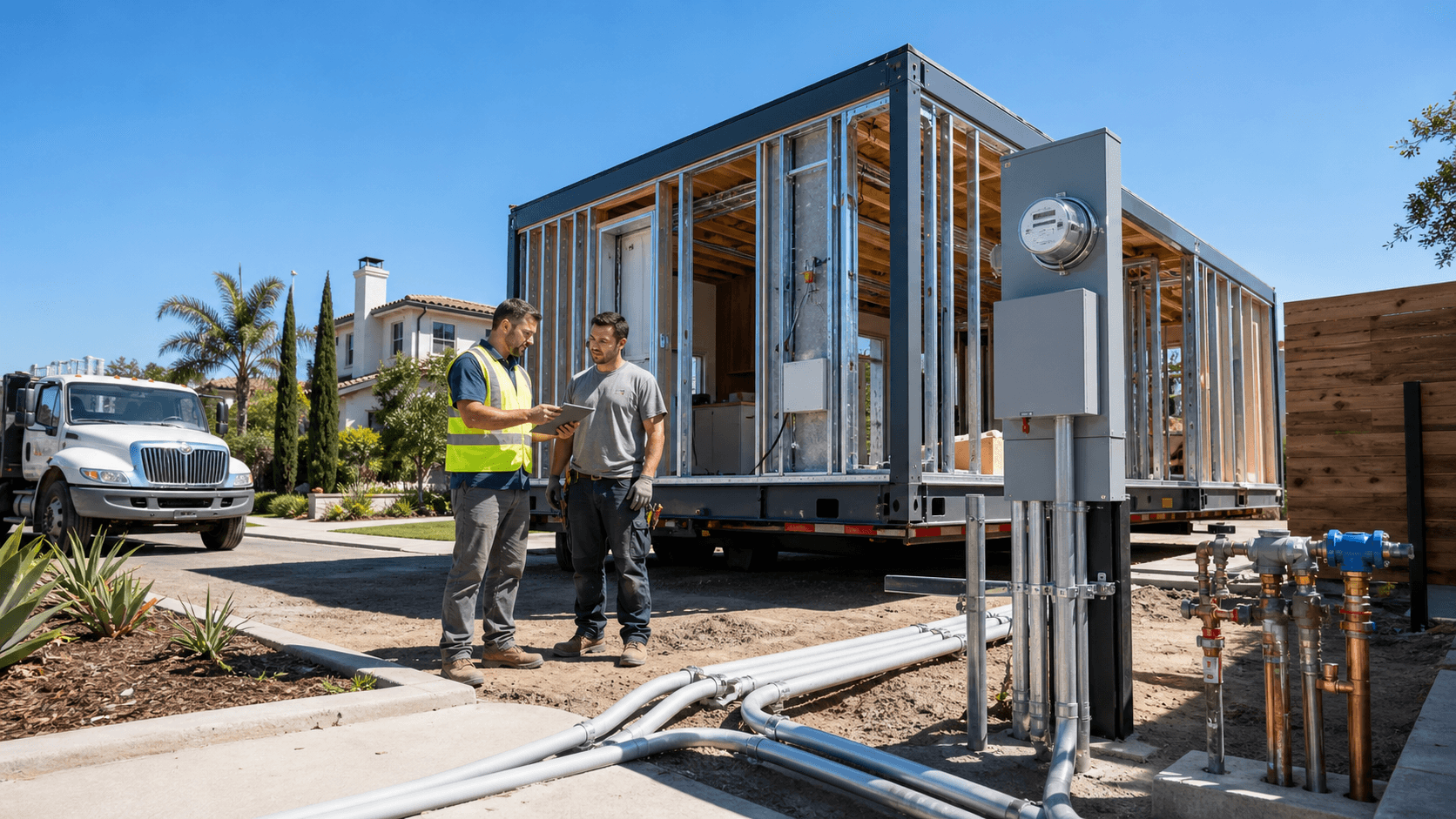
Understanding Modular Home Delivery for California Utilities
Modular home delivery is changing how California utilities build crew housing and utility-adjacent buildings. When fire risk, seismic demands, and labor shortages all hit at once, the old way of stick-building every structure on site starts to feel slow and risky. Utilities, developers, architects, builders, and public agencies are looking for more predictable ways to deliver safe, durable space on tight schedules.
In this guide, we walk through how modular, panelized, and hybrid delivery can work on real utility sites. We focus on high fire zones, seismic performance, outage windows, and the approvals that actually matter. Our team at Fast Struct builds with a precision-engineered light-gauge steel system, not traditional wood framing, so the details look a little different from what many people expect when they hear "modular."
Why Utilities Are Turning to Precision Steel Construction
Utility work has its own pressures. Buildings are not just "projects," they are part of keeping power and services running. Crews need safe places to live and work near substations, operations centers, and remote assets, often on land with strict access and safety rules.
Utilities are under steady pressure from:
- Wildfire risk in high fire zones
- Seismic demands along faults
- Short outage windows to do work near live equipment
- Tight labor markets that make traditional framing hard to staff
This is why Fast Struct focuses on a U.S.-made, precision-engineered light-gauge steel system instead of a one-size-fits-all modular approach. For crew housing, control buildings, operations centers, and support facilities, this type of framing offers:
- Non-combustible structure for better fire performance
- No rot, warp, or shrink in the framing
- Better dimensional stability over time
- Factory precision for cleaner assembly and reduced rework
That combination fits California's regulatory and environmental context, especially for fire and seismic performance. Factory precision, reduced rework, and a cleaner assembly process help utilities hit strict program timelines, especially when construction has to wrap up before peak demand periods or major maintenance seasons.
How Modular Home Delivery Works for Utility Projects
When we say "modular home delivery," we are talking about high-precision, light-gauge steel 3D volumes built in our Santa Clara factory. These are the rooms and cores that benefit most from being fabricated in a controlled environment, where we can keep tolerances tight and inspections predictable.
Here is how that looks for utility-related projects:
- 3D volumes are framed from U.S.-made light-gauge steel and assembled in Santa Clara
- HCD or HCD-approved agencies review and inspect the factory-built components manufactured off-site
- Volumes are shipped to the site and set on prepared foundations
- On-site crews connect utilities, complete any field scope, and finish integration
Permitting and inspections are clearly split:
- HCD or HCD-approved agencies cover the off-site, factory-built modules and other factory-built components
- Local jurisdictions review and inspect foundations, grading, utility tie-ins, zoning, installation, and all work outside the approved factory-built scope
For utilities and their partners, this split matters. It means fewer unknowns in the field, a more predictable inspection path, and faster commissioning once foundations are ready. Depending on the project type, modular units can arrive substantially complete inside, so interior work on sleeping quarters or offices is not fighting for space with other site trades. Modular delivery with Fast Struct centers on faster delivery of more finished 3D-volume volumes, making it ideal where schedule and repeatable room types are the priority.
Panelized Steel Systems for Complex Utility Sites
Not every utility site can accept large 3D volumes. Access roads might be tight. Hillside terrain might limit crane setup. Existing infrastructure might leave little room to swing big boxes into place. That is where panelized delivery gives architects, developers, builders, and utility planners a different option.
With panelized delivery, Fast Struct fabricates:
- Wall panels
- Floor panels
- Roof panels
All from the same U.S.-made, precision-engineered light-gauge steel system. Panels are precision-cut and factory-assembled as needed, then delivered flat and erected quickly on site.
Panelized delivery is often a better fit when:
- Lots are tight, urban, or built into slopes
- Access roads restrict truck size or turning radius
- Layouts are highly custom and must bend around existing infrastructure
- Work must be phased around live operations and sensitive equipment
Utilities benefit from:
- Cleaner assembly, since panels arrive pre-cut and organized
- Less on-site cutting and waste around critical assets
- The same non-combustible, dimensionally stable framing that avoids rot, warping, or shrinkage
Panelized delivery provides more flexibility for tight lots and custom designs, while still leveraging factory precision, reduced rework, and digital planning.
Hybrid Delivery for Utility-Scale Speed and Flexibility
For many utility projects, neither fully modular nor fully panelized is perfect on its own. Crew housing might need fast, repeatable sleeping units, while storage, corridors, and specialty spaces have to snake around existing structures. That is when Fast Struct turns to a hybrid delivery method.
Hybrid delivery means we mix:
- Modular units where speed and interior completion matter most, such as bedrooms, offices, and core service rooms
- Panelized assemblies where on-site flexibility is key, such as connector corridors, storage bays, or specialty technical rooms
We do not force every client into one delivery method. Instead, our team studies:
- Site conditions and access
- Design complexity and custom needs
- Schedule pressures and outage windows
- Jurisdictional requirements, including HCD and local reviews
Hybrid is the best fit delivery method when projects need both the faster delivery of more finished 3D volumes and the on-site flexibility of panelized assemblies.
Under the hood, this is all powered by a high-tech, digital workflow that connects design, engineering, and manufacturing. Plans are converted into production-ready files that feed directly into our steel framing machines. Those machines cut and form U.S.-made steel with high precision. Assemblies go through factory QA before arriving on site, then our licensed contractor team manages on-site integration so the whole system ties together cleanly in the field.
From Permit Approval to Turnkey Utility Facilities
After permit approval, many Fast Struct projects move from fabrication to completion in approximately 3 to 5 months, depending on site conditions, utility work, jurisdictional requirements, and overall scope. That timeline is significantly faster than a typical ground-up stick-built schedule, especially in high-demand, labor-constrained California markets.
Speed is only helpful if coordination keeps up. Fast Struct's showroom and factory in Santa Clara, in the heart of Silicon Valley and minutes from major tech headquarters, gives utilities and their partners a place to see the precision-engineered light-gauge steel system in person. Project teams can walk actual assemblies, review details, and align on how modular, panelized, or hybrid delivery will work on a specific site.
We hold a rare mix of licenses that supports this A-to-Z model: Fast Struct is a state-approved, HCD-licensed manufacturer, a licensed general contractor, and we carry commercial licensing. That combination of licenses, home manufacturing, general contracting, and commercial, allows one integrated team to manage the full path, from early planning through design coordination, engineering, manufacturing, field installation, commissioning, and closeout, instead of handing the project off between multiple firms.
For California utilities, developers, architects, and builders, that one-team approach can turn modular home delivery from a buzzword into a practical tool. By choosing the right construction and delivery method for each project, modular for faster delivery of finished 3D volumes, panelized for greater flexibility on tight or complex sites, and hybrid as the best-fit blend based on site, design, and schedule, Fast Struct's precision-engineered light-gauge steel system helps teams meet fire, seismic, and labor challenges while still hitting tight program schedules.
Get Started With Your Project Today
If you are ready to move from planning to building, we are here to guide you every step of the way. Explore how our modular home delivery process keeps your project on schedule and on budget. At Fast Struct, we coordinate design, manufacturing, and installation so you can focus on the details that matter most. Have questions about timelines, sites, or custom options? Simply contact us and our team will walk you through your next steps.


