
California's Steel Era for Housing
California housing is changing fast. Fire risk, earthquakes, high labor costs, and a tight housing supply are all pushing the industry to build in smarter ways. More owners, developers, and architects are asking how to get safer, stronger homes without dragging projects out for years.
Light-gauge steel is at the center of that shift. When it is engineered in a factory and matched with the right delivery method, it can answer many of the state's biggest building challenges. In this guide, we explain why steel is rising, how the supply chain and codes work, what modular, panelized, and hybrid construction homes actually mean, and how to pick the right path for your own project.
Market Forces Pushing California Toward Steel
California is dealing with a mix of pressures that all point in one direction: we need buildings that are more resilient and more predictable to build.
Wildfire, seismic, and insurance realities are a big part of this. Non-combustible, precision-engineered light-gauge steel structures can help address:
- Wildfire exposure in high fire threat areas
- Seismic demands along fault zones
- Insurance concerns about long-term risk
Steel does not rot, warp, or shrink. That means fewer long-term surprises. In many homes, wood framing can twist or move over time, which can lead to cracks, stuck doors, and gaps in the building envelope. With steel, dimensional stability is stronger, which supports:
- Tighter building envelopes
- Cleaner finishes and straighter lines
- Less movement across variable microclimates from coast to inland areas
Labor is another big driver. Skilled construction workers are in short supply, especially in markets like the Bay Area and Los Angeles. On many sites, it is hard to find enough people, and even harder to keep timelines steady. Factory-built steel assemblies can reduce the amount of labor needed on site and cut down on rework. Once permits are approved, many projects using a factory-based system can move from fabrication to completion in about 3 to 5 months, depending on:
- Site access and conditions
- Utility work and tie-ins
- Local jurisdictional requirements
- Overall project scope
There is also growing demand from tech-enabled buyers and investors. People used to product launches and sprints want similar clarity from their buildings. They care about:
- Predictable timelines
- Data-driven design choices
- Systems that feel modern and precise
A digital, precision-engineered light-gauge steel system fits this mindset well and is especially attractive for infill lots, accessory units, and small multifamily buildings where speed and performance both matter.
Inside the Steel Supply Chain and Digital Factory Floor
A big reason steel is gaining ground is the quality and predictability of the material itself. With a controlled supply chain and a digital factory, we can treat structure more like a product and less like a one-off prototype.
We start with U.S.-made, high-quality light-gauge steel. That gives:
- Clear traceability of material
- Consistent strength and thickness
- Reliable supply compared to shifting lumber markets
The steel is non-combustible and protected against corrosion, which is especially important for coastal locations, hillside sites, and high fire threat zones. This approach supports long-term durability and helps reduce warranty issues and callbacks when the building is lived in, renovated, or sold later.
On the digital side, the process goes from plans to framing in a straight line. Architectural and engineering drawings are converted into production-ready files that feed steel framing machines directly. Each stud, track, and truss is:
- Cut to exact length
- Formed and punched for connections
- Labeled and organized for modules or panelized assemblies
In the factory, assemblies are test-fitted and checked before leaving Santa Clara. That means many of the problems that would usually show up on a job site get caught earlier. The result on site is cleaner assembly, less rework, and fewer surprises for installers and inspectors.
Being located in the heart of Silicon Valley, near major tech headquarters, also matters. It lets design teams, architects, and owners walk the floor, see raw coil turn into finished steel frames, and sit down with engineering and construction staff in the same building. Design, manufacturing, and building are connected under one roof instead of being split between separate vendors.
Modular, Panelized, and Hybrid Steel Explained
"Steel construction" is not just one thing. The delivery method matters as much as the material. For California sites, we see three main approaches: modular, panelized, and hybrid.
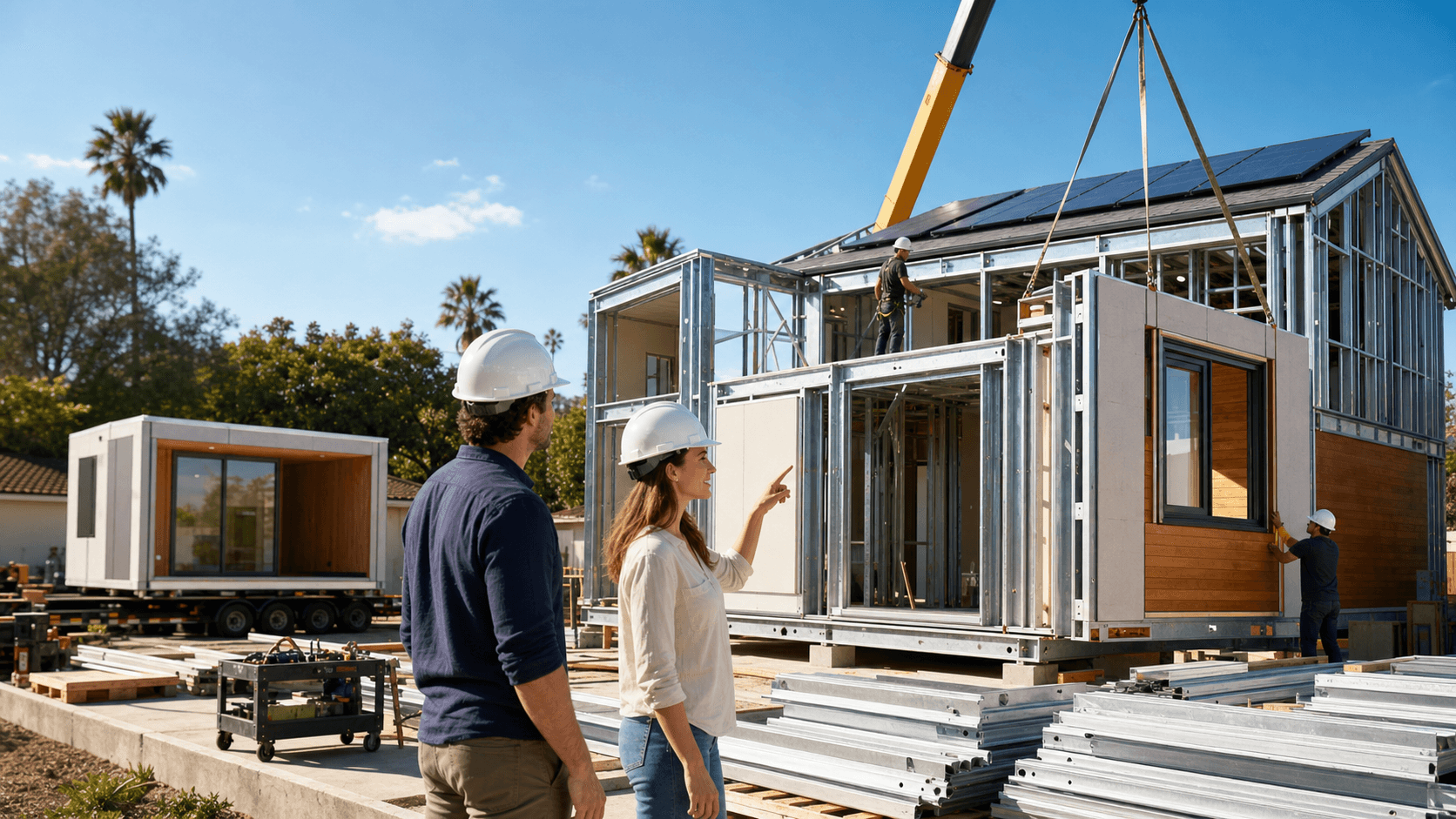
Modular steel homes use fully framed 3D volumes built in the factory. With our precision-engineered light-gauge steel system, these modules can include:
- Structural framing
- MEP rough-in
- Interior finishes and key fixtures, depending on the project
The modules travel to the site, get craned into place, and are connected together. This path is ideal when layouts repeat, such as accessory units or smaller multifamily stacks, and when maximum factory completion is the top priority.
Panelized steel systems are different. Instead of 3D boxes, we build wall, floor, and roof assemblies flat in the factory, then ship them to the site for assembly. This is often a better fit when:
- Lots are tight and crane access is tricky
- Sites are sloped or oddly shaped
- Designs are more custom or have unique massing
With panelization, architects have more flexibility with form, while still getting factory precision and a faster, cleaner structure on site.
Hybrid construction homes combine both methods. A project might use modular volumes where repetition gives big time savings, and panelized assemblies where site or design call for more freedom. Examples include:
- A small multifamily building with modular units stacked on a panelized podium
- A hillside custom home framed with panelized steel, plus modular accessory suites
The key is that there is no one-size-fits-all answer. The best method depends on that specific site, design, and schedule.
Codes, Approvals, and Inspections Made Simple
Factory-built steel does not skip the code process; it just divides it.
For the factory-built pieces, California's Department of Housing and Community Development, or HCD-approved agencies, review and inspect the work done off-site. As an HCD-licensed manufacturer, we have our precision-engineered light-gauge steel assemblies checked at the factory level so they meet state standards before they ever reach the property.
Local cities and counties still stay in charge of everything that is site-specific. That includes:
- Zoning and planning approvals
- Grading and foundation design
- Installation of modules or panels
- Utility connections and any field-built work
Local inspectors visit the site to review foundations, craning, and placement, and final connections. This dual framework gives owners, developers, and lenders confidence that both the factory-built components and the site work are being properly reviewed.
Fast Struct carries a rare mix of licenses: we are a licensed contractor and a state-approved, HCD-licensed manufacturer, with home manufacturing, general contractor, and commercial licenses. Many suppliers only handle manufacturing and leave owners to coordinate a separate general contractor and multiple subs. Our model is different. One team coordinates design, engineering, manufacturing, installation, and completion from start to finish.
Choosing the Right Steel Strategy for Your Project
So how do you pick between modular, panelized, and hybrid? It starts with a clear look at your site, your design goals, and your target schedule.
We help project teams consider:
- Site access and crane limits
- Lot size, setbacks, and height limits
- Topography and soil conditions
- Architectural complexity and desired customization
- Target move-in or delivery date
We then model different mixes of modular, panelized, and hybrid delivery to see which approach balances speed, flexibility, and risk the best for that specific project. No two projects use the exact same playbook. The method is chosen to fit the project, not the other way around.
From early feasibility to completion, the path is structured but still flexible. Early on, we review the site, align on concept design, and begin structural and steel system engineering. We check jurisdictional rules early so the HCD and local roles are clear. After permits are in hand, many projects move from fabrication start to completion in roughly 3 to 5 months, depending on utilities, site access, local review steps, and overall scope. Because the assemblies are built from coordinated digital models and tested in the factory, on-site work tends to be cleaner, with fewer change orders and less rework.
As California moves deeper into its "steel era," the goal is simple: build safer, faster, and smarter. With a precision-engineered light-gauge steel system, method-neutral delivery, and an integrated team from design through construction, we believe hybrid construction homes and steel framing are set to become a standard choice for many projects across the state.
Get Started With Your Project Today
If you are ready to explore how our hybrid construction homes can accelerate your build while maintaining quality, we are here to help. At Fast Struct, we collaborate with you and your team to align design, budget, and schedule from the start. Share a few details about your goals and constraints so we can propose a clear, practical path forward. To take the next step, contact us and start planning your project with our team.


