
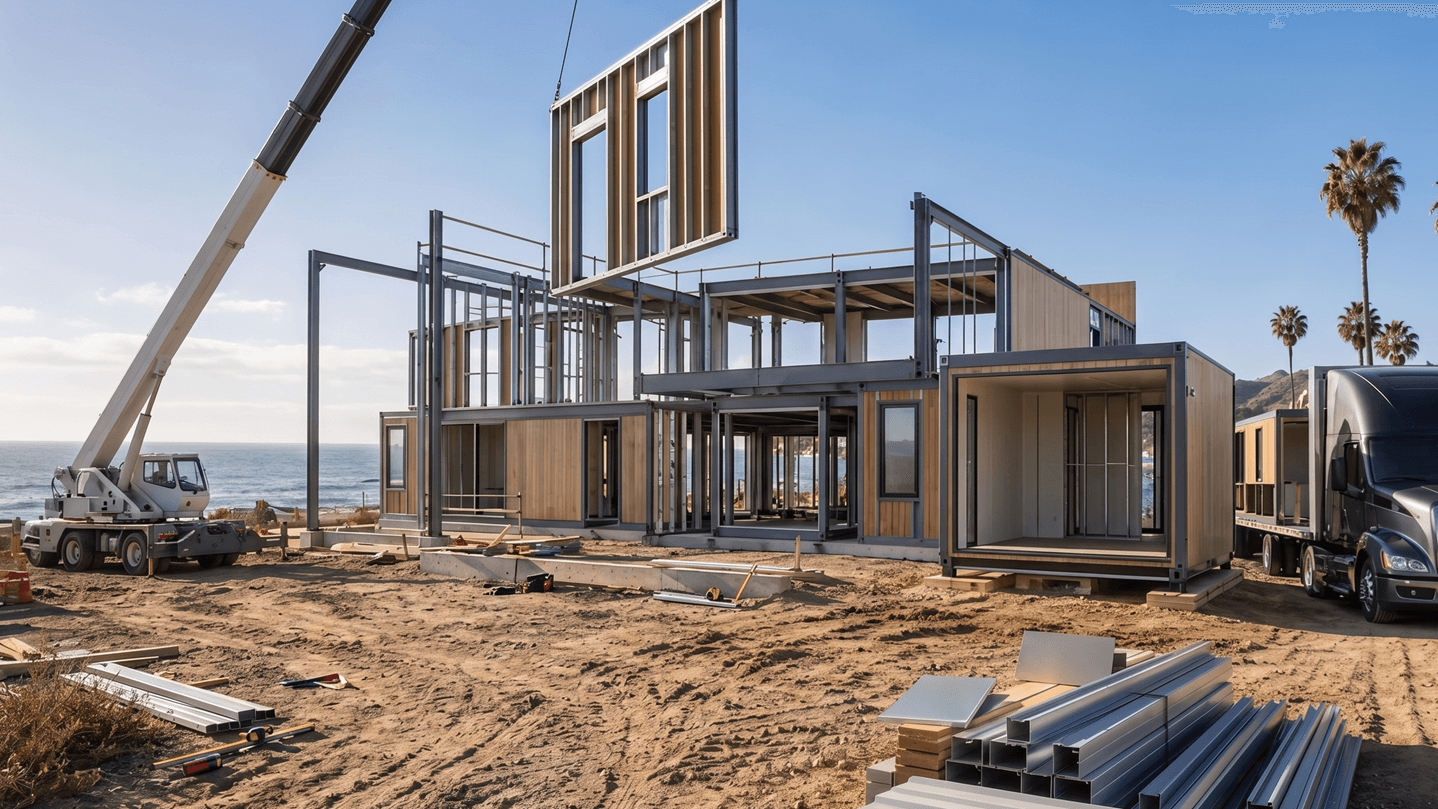
Choose a California Builder Who Fits Your Project, Not Theirs
Choosing a builder for hybrid construction homes in California is not the same as calling a traditional stick-built contractor. You are not just picking someone to manage lumber, trades, and inspections. You are choosing how much of your home is built in a factory, how it ships, how it ties into your site, and who is actually responsible when something is off by an inch.
That is why the first question is not "Who has the lowest bid?" It is "Who is willing to shape the construction method around my site, my zoning, my schedule, and my budget?" Some teams sell only one system, then try to bend every project to match it. That can work on a perfect site, but many California lots are not perfect.
At Fast Struct, we flip that. We start with your project and then choose between modular, panelized, or a hybrid mix. We are a Silicon Valley-based, technology-driven factory and licensed contractor with a state-approved, HCD manufacturing facility in Santa Clara. Our design, engineering, and manufacturing teams sit under one roof, so we can pick what actually fits your site, not what is easiest for a single factory line, as you head into the busy spring and summer building months when delays and labor gaps tend to grow.
Modular, Panelized, and Hybrid Steel: What You Are Really Choosing
Before you compare builders, it helps to know what they are really offering.
Modular construction means we create precision-engineered light-gauge steel 3D volumes in the factory. Depending on your project type, these modules can arrive substantially complete, with framing and many interior and exterior elements already advanced. They are trucked to your site and lifted into place for very rapid installation. Modular works especially well when you have:
- Repeatable units or mirrored layouts
- Reasonably clear site access for trucks and cranes
- Tight schedules that need predictable factory work
Panelized construction is different. Here, we fabricate precision-engineered light-gauge steel wall, floor, and roof panels that ship flat. These pieces are then assembled on site, like a high-quality kit that goes together quickly while preserving design flexibility. Panelized systems are often the better choice when you have:
- Tight or urban lots where large modules cannot reach
- Custom footprints or setbacks that do not repeat
- Additions or partial rebuilds that must tie into existing work
Hybrid construction homes blend both methods. On one project, a builder might use modular units for bedrooms and baths, and panelized elements for a custom living area that wraps a patio or fits a slope. The mix depends on:
- Topography and access
- Architectural design
- Jurisdictional requirements
- Schedule priorities and budget
The material system under all of this matters. Our framing is a precision-engineered light-gauge steel system made with U.S.-made, high-quality, non-combustible steel. It does not rot, warp, or shrink, and it holds its shape with much better dimensional stability. That means factory precision, cleaner assembly, fewer surprises during finishes, reduced rework, and performance that is well suited to California fire, seismic, and labor challenges.
Key RFP Questions for Hybrid Steel Builders
When you prepare a request for proposals, do not just ask for a price and schedule. Ask how each team thinks.
Start with how they select the construction method. Ask: "For my site and design, how would you decide between modular, panelized, or a hybrid?" Listen for project-specific thinking, not a one-size-fits-all pitch. Our own process is method agnostic. We run your zoning, site, and priorities through our design and engineering team, then recommend the modular, panelized, or hybrid delivery method that best fits.
Next, ask about the design-to-factory workflow:
- How do my architectural plans become digital files for your framing machines?
- How do you control tolerances in the factory?
- How do you capture as-built data to support the field crew?
At Fast Struct, our digital process connects design, engineering, and manufacturing. Plans are converted into production-ready files that drive our steel framing machines. U.S.-made steel is cut and formed with high precision, then assemblies pass through factory QA before shipping.
Licenses and approvals are another big topic. Ask if the builder is:
- A licensed contractor
- A state-approved / HCD manufacturer
- Handling both commercial and residential scope
Fast Struct holds licenses across home manufacturing, general contracting, and commercial work, which helps keep responsibility clear from factory to final inspection.
Finally, verify material and system quality. Ask where the steel comes from, what framing system is used, and how tolerances are checked. Look for clear, specific answers rather than generic language. Our projects are framed with a precision-engineered light-gauge steel system using U.S.-made materials and factory-controlled precision.
Scope Splits, Inspections, and Coordination Risk
Hybrid construction only works smoothly when everyone knows where their job starts and ends. That begins with understanding who inspects what.
For factory-built components, HCD or HCD-approved agencies review and inspect what is manufactured off site. Local building departments focus on foundations, grading, utilities, installation, zoning compliance, and any work outside the approved factory-built scope. Both sides matter, and both must be aligned.
Ask each builder for a clear scope matrix that spells out:
- Design and engineering
- Factory fabrication and QA
- Transport and crane work
- Installation and structural connections
- Site utilities, grading, and flatwork
- Interior and exterior finishes
- All inspections and sign-offs
We build these scope splits line by line so there is less finger pointing and fewer surprise change orders.
Coordination practices may be the biggest difference between a smooth hybrid project and a stressful one. Ask how they sequence factory work with site work, how they manage inspections, and how trades are lined up to close walls and finishes after modules or panels arrive. Our integrated digital workflow links engineering, manufacturing, and site construction, which lowers coordination risk compared with juggling separate vendors.
On timelines, skip the vague promises. Ask for a schedule range that considers your specific jurisdiction, utility providers, and site conditions. After permit approval, many Fast Struct projects move from fabrication to completion in approximately three to five months, depending on site conditions, utility work, jurisdictional requirements, and scope. That is still significantly faster than traditional stick-built work, but also grounded in real-world steps.
Warranties, Performance, and Long-Term Risk
When you compare builders, do not lump all warranties together. Ask for separate clarity on:
- The precision-engineered light-gauge steel structure
- Factory-built assemblies
- Site-installed finishes and systems
Because Fast Struct is both the manufacturer and the contractor, we can streamline responsibility for structural and installation issues. You know who to call if something does not perform the way it should.
California-specific performance should also be part of your list. Non-combustible steel framing, higher dimensional stability, and factory-level QA can help manage wildfire exposure, seismic demands, and uneven labor quality. Compared with traditional framing, our steel system will not rot, warp, or shrink, which supports straighter lines, tighter connections, and fewer callbacks.
Ask about service too. How are punch lists created and tracked? What digital documentation is kept for your home? Our digitally driven manufacturing process keeps a clear record of what was built, which supports troubleshooting and long-term maintenance.
Finally, consider resale and appraisal. Documented engineering, inspections by HCD and local authorities, and a precision-engineered light-gauge steel system can support appraisers, insurance providers, and future buyers. Clear records and clear structure often lead to more confidence over time.
Visit Fast Struct in Santa Clara and Start Scoping Your Project
If you are serious about hybrid construction homes, nothing beats seeing the process up close. At our showroom and factory in Santa Clara, in the heart of Silicon Valley and minutes from major tech headquarters, you can watch our light-gauge steel framing machines at work, see how assemblies come together, and review the quality control steps we follow before anything leaves the floor.
Bring what you already know about your site, your early design ideas, and your schedule priorities. We will walk through whether modular, panelized, or a hybrid delivery is the best match, instead of forcing you into a single system. You can also use the RFP questions in this article as a checklist for any builder, then compare those answers with the way our integrated team handles design, engineering, manufacturing, and construction from one place.
Get Started With Your Project Today
Explore how our hybrid construction homes can fit your specific live and work needs, from layout flexibility to long-term durability. At Fast Struct, we collaborate with you to align budget, timeline, and design so your project moves forward with confidence. If you are ready to talk through options, preferences, or next steps, simply contact us and our team will follow up with clear, practical guidance.


