
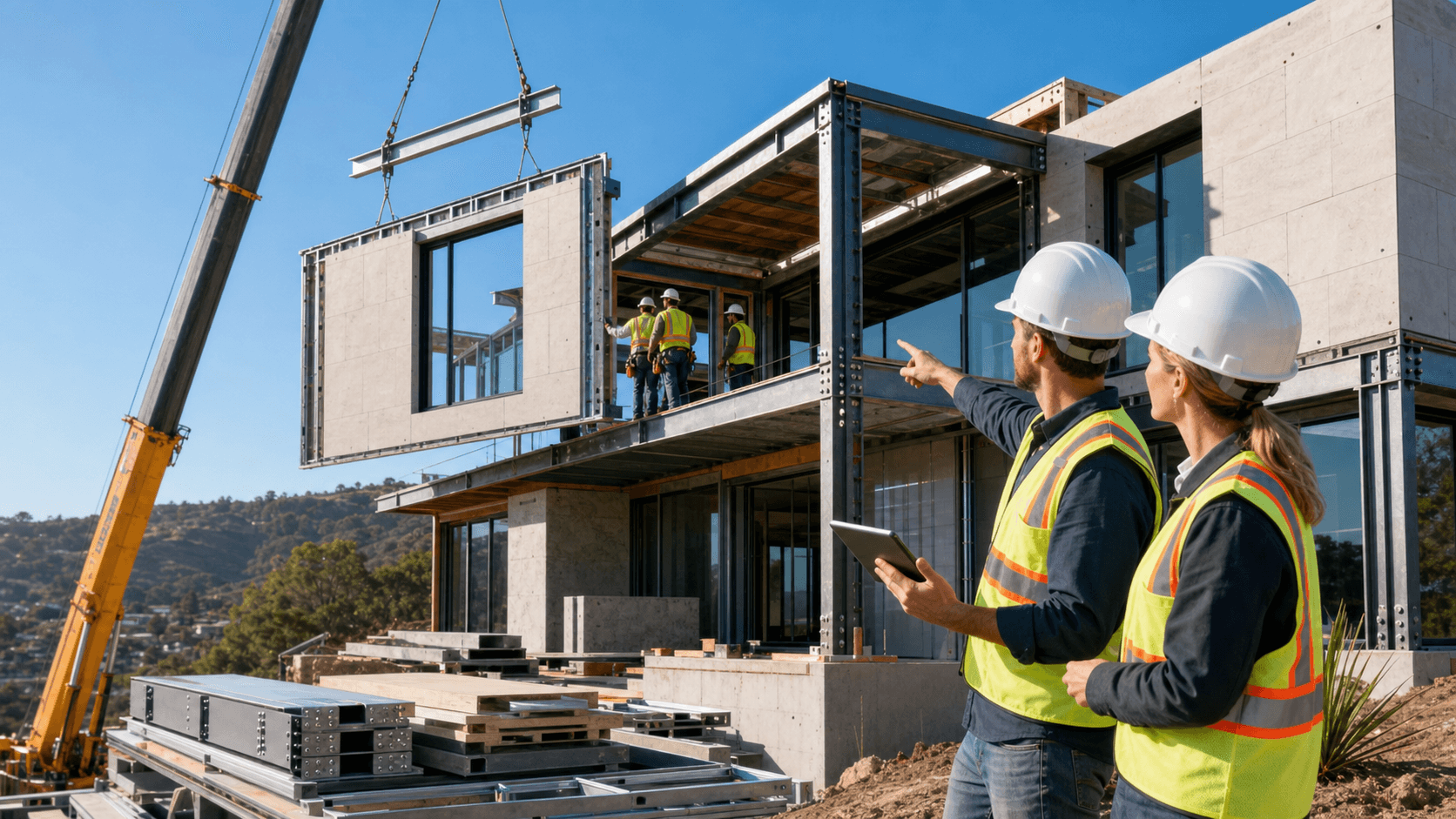
Building safer, smarter homes in California starts with addressing the realities of wildfire risk, seismic activity, and construction pressure. We live with long wildfire seasons, regular earthquakes, and constant pressure on labor and timelines. Traditional wood framing was not designed for this mix of fire risk, seismic movement, and tight schedules.
Hybrid construction homes give developers, architects, builders, and homeowners a better way forward. By blending modular and panelized light-gauge steel systems, we can match the method to the project instead of forcing a single template. At Fast Struct in Santa Clara, we focus on precision-engineered light-gauge steel and then choose modular, panelized, or a hybrid mix based on the site, design, and schedule.
Building Smarter for California's Fire and Quake Reality
California projects must balance many pressures at once. On one side, there are fire zones, seismic codes, and complex local approvals. On the other, there are labor shortages, schedule demands, and the need for predictable quality.
Hybrid construction homes fit this reality because they are:
- Built with non-combustible light-gauge steel
- Produced with factory precision instead of only on-site labor
- Planned around local access, slopes, and jurisdiction rules
Our role is to look at your site, your design, and your timeline, then decide which delivery method makes the most sense. Sometimes that is mostly modular. Sometimes it is mostly panelized. Often, the best answer is a hybrid that blends both.
What Makes a Home "Hybrid" in Modern Construction
A hybrid construction home is not a single product. It is a project that uses both fully finished modular volumes and panelized wall, floor, and roof systems on the same job, on purpose.
Here is how the parts break down in simple terms:
- Modular units are 3D volumes that can arrive substantially complete, with walls, floors, and roofs already built, and often with much of the interior work done.
- Panelized systems are flat wall, floor, and roof assemblies that ship in sections, then are quickly erected on site like a kit with a prepared plan.
Modular volumes are great for repeated elements, like stacked units with the same layout or where speed and less on-site labor are top priorities. Panelized systems shine on tight urban lots, tucked-away backyards, complex topography, and highly customized designs.
At Fast Struct, we do a best-fit analysis for each project. We look at:
- Site access and crane reach
- Topography and soil work
- Design complexity and unit repeatability
- Local jurisdiction and approval path
- Schedule pressure and labor needs
Then we suggest modular, panelized, or a hybrid mix instead of forcing every build into a single delivery method.
Why Light-Gauge Steel Matters for Fire and Seismic Safety
The material at the core of the system matters as much as the method. We focus on precision-engineered light-gauge steel, produced in the U.S., because it fits California's fire and seismic needs far better than traditional wood framing.
Key benefits of light-gauge steel include:
- Non-combustible structure that does not ignite like wood
- No rot, warp, or shrink as the structure ages
- Better dimensional stability across different California climates
Because we form the steel framing in a controlled factory, each piece is cut and shaped with tight tolerances. That helps engineers plan clean load paths, straighter walls, and consistent connections that support better seismic detailing.
For wildfire and ember exposure, steel framing gives a strong base for:
- Non-combustible exterior cladding systems
- Tighter joints, fewer gaps, and fewer rough cuts on site
- Cleaner assemblies with less exposed scrap and debris
This approach fits especially well in high fire risk zones, where structure, layout, and exterior materials all need to work together.
Inside Fast Struct's High-Tech Hybrid Workflow
Our process connects design, engineering, and manufacturing from the very beginning. Architectural and engineering plans are converted into production-ready files that feed directly into our steel framing machines in Santa Clara. Each stud and track is cut, punched, and formed with high precision.
In the factory, we:
- Pre-fit assemblies to confirm alignments and connections
- Inspect modular volumes and panelized elements for quality
- Use U.S.-made steel and top-tier materials
This factory QA reduces surprises on site and cuts down on rework. Panels line up, modular units connect as planned, and the installation crew can focus on assembly instead of field fixes.
Permitting and inspections follow a shared model:
- State agencies such as HCD or HCD-approved agencies review and inspect the factory-built components off-site.
- Local building departments still handle zoning, foundations, grading, utilities, and all site installation inspections.
This split moves complex fabrication into a controlled environment while allowing local officials to oversee site-specific safety and code compliance.
Choosing Modular, Panelized, or Hybrid for Your Project
Not every project should be fully modular, and not every project works best with only panelized systems. The right approach depends on your site and goals.
Modular focus makes sense when:
- You have repeated unit types or stacked layouts
- The schedule is tight and on-site disruption must stay low
- You want more work done off-site before units arrive
Panelized focus works well when:
- The lot is narrow, urban, or hard to access
- The site is sloped, irregular, or has complex foundations
- The design is highly customized or needs more flexibility on site
A hybrid strategy blends both. For example, you might:
- Use modular volumes for repeatable cores or unit blocks
- Use panelized systems for unique wings, connectors, or roof forms
- Mix methods to respond to crane limits, staging space, or neighborhood rules
Our team studies access, jurisdictional processes, fire and seismic risk, budget goals, and timeline to create a tailored mix instead of defaulting to a single method.
Timelines, On-Site Assembly, and One-Team Delivery
After permits are approved, many Fast Struct projects move from fabrication to completion in roughly 3 to 5 months, depending on site conditions, utility coordination, local requirements, and scope. This is typically significantly faster than a traditional stick-built path.
On site, the work usually looks like this:
- Foundations, utilities, and grading are completed under local inspection.
- Depending on the project type, modular units can arrive substantially complete and are set on the prepared foundation.
- Panelized wall, floor, and roof systems are rapidly assembled for areas that need more flexibility.
- Final connections, finishes, and inspections are completed with local building departments.
One of our key strengths is that we are both a state-approved, HCD-licensed manufacturer and a licensed contractor, with home manufacturing, general contractor, and commercial licenses. That means one accountable team from design coordination and engineering through fabrication, installation, and closeout.
Fast Struct operates from a showroom and factory in Santa Clara, in the heart of Silicon Valley, close to major tech headquarters and directly in the market we serve. Our focus is not just on delivering "modular," but on applying a precision-engineered light-gauge steel system with the right mix of modular, panelized, and hybrid construction homes for each California fire, seismic, and labor challenge.
Plan Your Next California Project with a Hybrid Mindset
When you look at your next project, think beyond traditional wood framing. Consider your fire zone, seismic needs, access limits, and how much on-site labor you can realistically support. A hybrid construction home approach lets you balance safety, schedule, and design freedom instead of trading one for the other.
At Fast Struct, we review concepts, study the site, compare modular versus panelized versus hybrid options, and align budget and timeline with an approval strategy that fits both HCD and local jurisdictions. This hybrid mindset, backed by U.S.-made light-gauge steel and a high-tech factory process, is built for how California really builds today.
Get Started With Your Hybrid Home Project Today
Discover how our hybrid construction homes can give you faster build times, lasting durability, and architectural freedom. At Fast Struct, we work closely with you and your design team to align schedule, budget, and performance from day one. If you are ready to explore a project or need guidance on next steps, contact us so we can discuss your goals and timeline.


