
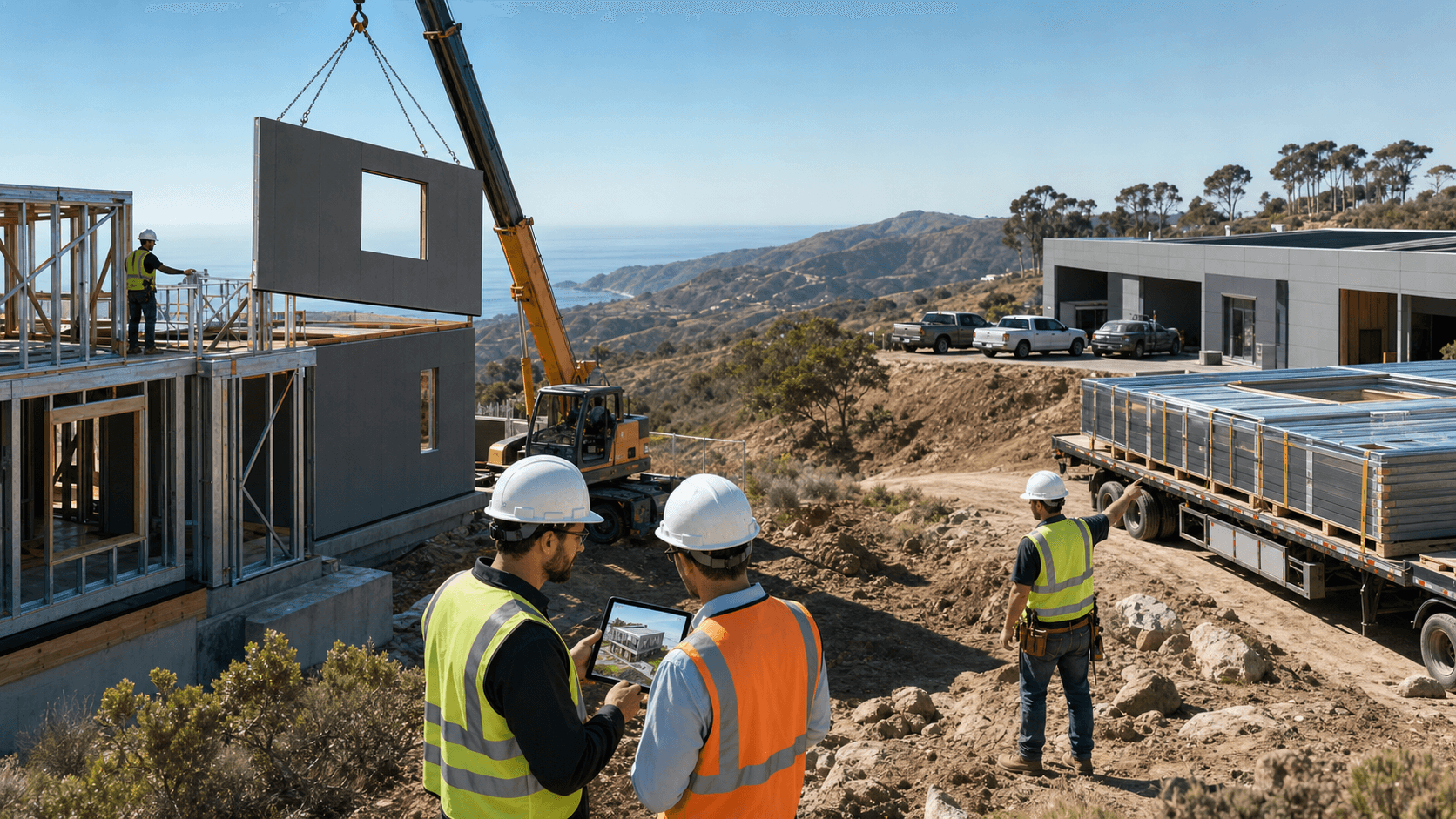
Rethinking Modular Construction for California Sites
Modular construction is often presented as the ideal solution for California housing. Faster build times, cleaner job sites, less noise for neighbors; it all sounds great. But if you have ever looked at a real property here, you know it is rarely that simple.
Every site has quirks. Infill lots squeezed between existing homes, hillside parcels with tricky access, and tight urban streets all change how modular construction actually works. That is why we question generic promises about the benefits of modular construction and focus instead on choosing the right construction method for each project, matching the delivery method to your exact site and design.
We are a Silicon Valley-based, state-approved manufacturer and licensed contractor building with a precision-engineered light-gauge steel system. Our showroom and factory are located in Santa Clara, in the heart of Silicon Valley and minutes from major tech headquarters. For us, modular is not a one-size-fits-all label. It is one delivery method, alongside panelized and hybrid strategies, that we use to help California homeowners, developers, architects, and builders get better results.
What Most Articles Miss About Modular Construction
You have probably heard the standard modular claims:
- Faster schedules
- Factory quality
- Less disruption on site
- More predictable outcomes
Those points can be true, but only when they are lined up with real site conditions. In California, a lot can change once you look at:
- Street access and turning radius for trucks
- Space and timing for cranes
- Utility locations and upgrades
- Zoning rules, fire setbacks, and local review steps
On an open, easy-to-reach site, big volumetric modular boxes can make sense. On a tight infill lot, a flag lot behind another home, or a hillside property, those same boxes might create more cost and stress. Getting long trucks into small streets, closing roads for cranes, or squeezing modules over mature trees can become a major challenge.
This is where our core difference comes in. We start with the site, the design, the schedule, and the jurisdiction. Then we choose modular, panelized, or a hybrid method around our precision-engineered light-gauge steel system, instead of forcing everything into a modular-only approach.
Inside Our Precision-Engineered Light-Gauge Steel System
At the heart of our work is steel, not guesswork. We use U.S.-made, high-quality light-gauge steel that is cut and formed in our Santa Clara factory. Design, engineering, and manufacturing are all tied together in a high-tech digital workflow. Your plans are converted into production-ready files that feed directly into our steel framing machines, so every member is cut and formed with high precision.
This precision-engineered light-gauge steel system brings specific performance benefits for California:
- Non-combustible structure suited to wildfire risk areas
- No rot, warp, or shrink like traditional wood framing
- Better dimensional stability for crisp lines and tight fits
- Factory precision for consistent, repeatable quality
- Cleaner assembly on site with less waste and debris
- Reduced rework because parts actually match the model
For a state with real seismic demands, that stability matters. Our steel assemblies, panels, and modules go through factory QA before anything reaches your site. Using top-quality, U.S.-made steel and a consistent digital workflow gives you a more specific version of "factory quality" than many generic modular claims, because it is built around a single, consistent, precision-engineered light-gauge steel system.
Modular, Panelized, OR Hybrid: Matching Method to Site
We do not treat modular as a universal answer. We select among modular, panelized, and hybrid delivery based on your site, design, and schedule.
Modular: Faster Delivery with Finished 3D Volumes
Our modular approach uses our precision-engineered light-gauge steel system to create 3D volumes in the factory. Depending on the project type, those modular units can arrive substantially complete, with many interior elements already in place. This approach emphasizes:
- Faster delivery from fabrication to install using finished 3D volumes
- Fewer labor hours on site
- Less exposure to weather and schedule spikes during busy building seasons
For many modular or modular-heavy hybrid projects, moving from fabrication to completion in roughly three to five months after permit approval is realistic, depending on site conditions, utilities, jurisdictional reviews, and overall scope. That is still significantly faster than traditional site-built work, without promising impossible timelines.
Panelized: More Flexibility, Assembled on Site
Panelized systems use that same precision-engineered light-gauge steel, but instead of 3D boxes, we create flat wall, floor, and roof panels that ship more easily and are assembled rapidly on site. This panelized approach offers more flexibility and is often a better fit for:
- Infill lots and flag lots with limited access
- Hillside properties where crane reach is tricky
- Custom footprints that do not fit standard modular box sizes
- Architectural designs that want more freedom in layout and openings
With panelized delivery, trucks carry stacked panels instead of tall modules, cranes can be smaller, and installers can thread components into tight spaces. You still get the non-combustible steel frame, factory precision, cleaner assembly, and fewer site-built errors, but with more flexibility in design and site logistics.
Hybrid: Best-Fit Combination for Site, Design, and Schedule
Hybrid delivery often becomes the smart middle path. We combine modular and panelized systems to create a best-fit solution based on site, design, and schedule. A project might use:
- Modular steel units for repeatable cores, such as bathrooms or kitchens
- Panelized steel systems for custom wings, open living spaces, or tricky corners
- Site-built elements only where they truly make sense
We treat hybrid projects as tailored systems, not compromises. Our team looks at site access, structural needs, schedule, and local rules, then chooses the right mix of factory-built modules and panelized parts to protect design intent while capturing the benefits of modular construction where they matter most.
Permitting, One Team, and Local Expertise
Factory-built work in California adds another layer, but it does not have to be confusing. For the parts we manufacture off-site, the California Department of Housing and Community Development (HCD), or HCD-approved agencies, review and inspect those factory-built components. That includes structural elements, life safety, and relevant code items inside our approved factory-built scope.
Local building departments still handle everything that is tied to the site itself. That usually means:
- Foundations and slabs
- Grading and drainage
- Utility runs and hookups
- Zoning and planning rules
- Installation of factory-built units and any non-factory work
We hold a rare mix of credentials as a state-approved, HCD-licensed home manufacturer, a licensed general contractor, and holder of commercial licenses. That combination lets one integrated team coordinate between state and local reviews instead of leaving you to bridge the gap between a distant manufacturer and a separate builder.
From early design with architects, developers, and builders, through engineering, steel fabrication in Santa Clara, and on-site assembly, we work from a shared digital model. The same team that understands the design is responsible for the precision-engineered light-gauge steel system and the final install. That "one team from start to finish" approach reduces finger-pointing, keeps communication clearer, and gives your project a single accountable partner in the heart of Silicon Valley.
Choosing the right strategy for a California site is not about picking modular by default; it is about choosing the right mix of modular, panelized, and hybrid steel systems for your exact conditions and goals.
Get Started With Your Project Today
Discover how Fast Struct can streamline your next project with the proven benefits of modular construction. We collaborate with you from concept to completion so you can reduce timelines, improve quality, and control costs with confidence. If you are ready to turn your plans into a buildable solution, contact us and let our team walk you through the next steps.


