
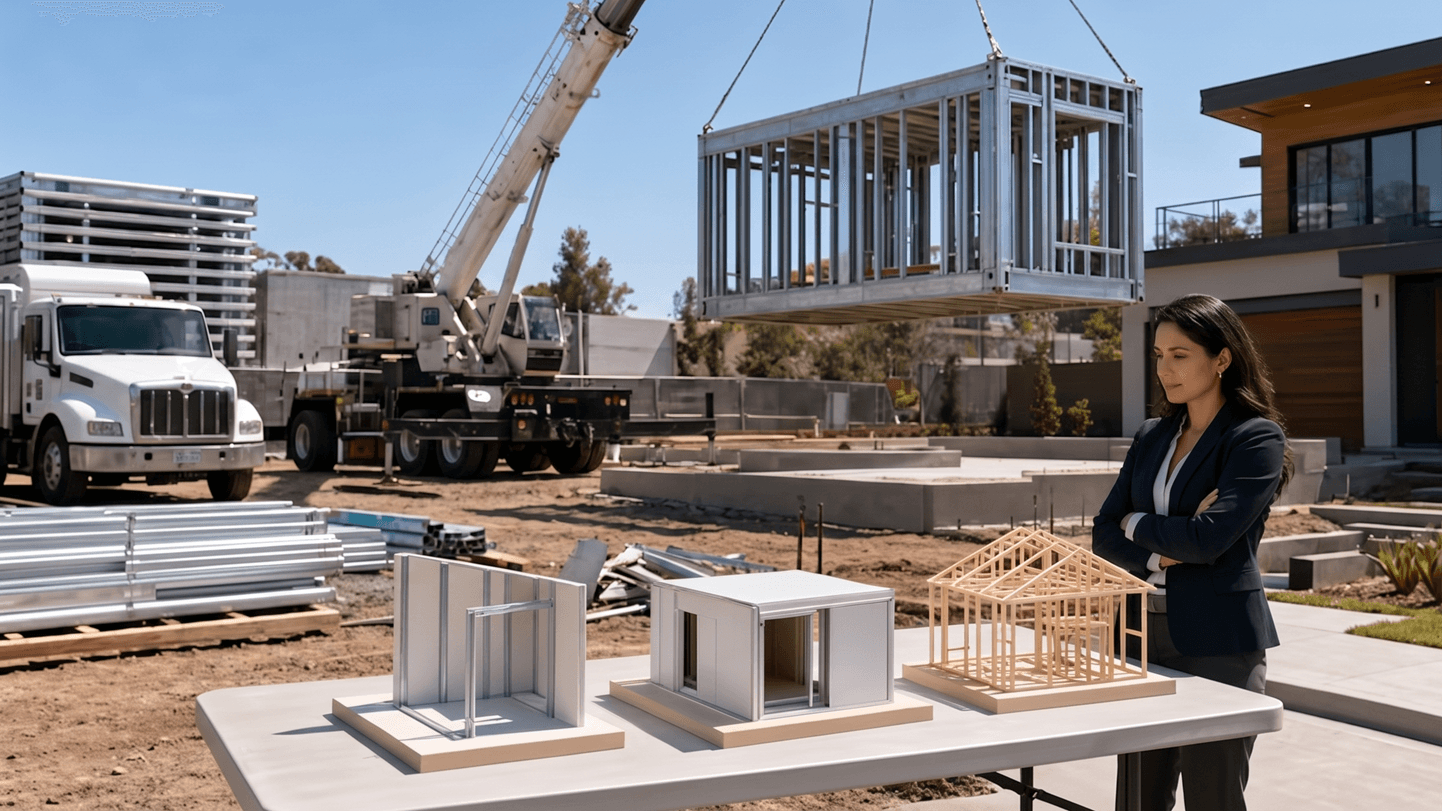
Choosing the Right Off-Site Construction Path for Your Home
Off-site construction is becoming a clear path for many California homeowners who want a faster, cleaner, and more predictable build. Fire risk, seismic codes, labor shortages, and long site timelines all push people to look for a smarter way to build a home or accessory unit.
Our team at Fast Struct works with a precision-engineered light-gauge steel system in our factory and showroom in Santa Clara. We are a licensed home manufacturer and a licensed contractor, with factory-built components reviewed and inspected under California Department of Housing and Community Development (HCD) oversight, and we focus on one main idea: there is no single method that works for every project. Instead of forcing every home into one box, we help you decide whether modular, panelized, or a hybrid approach fits your site, your design, and your schedule.
In this article, we will walk through how each off-site construction method works in simple terms. We will talk about what makes our U.S.-made steel system different and how the permitting process works in California when you mix factory-built components with local inspections.
Why Off-Site Construction Fits California Projects
When we say off-site construction, we mean this: key building components are built in a controlled factory using precision-engineered light-gauge steel, then shipped to your property for faster, cleaner assembly. You still get a real home on a real foundation, but much of the structure is prepared ahead of time under a roof.
For California, the fit is very clear. Many sites face wildfire risk and stricter seismic rules, and many areas have tight labor conditions. Our light-gauge steel system uses U.S.-made high-quality steel that is non-combustible, so it does not burn like wood. It also does not rot, warp, or shrink, which supports:
- Straighter walls and flatter ceilings
- Better fits for cabinets, tile, and modern finishes
- Less cracking and movement over time
- Fewer surprises during inspections
Inside the Santa Clara factory, digital steel framing machines cut and form steel members to exact dimensions. Assemblies are QA-checked before they ever reach your street. That means:
- Cleaner job sites with less scrap and sawdust
- Shorter time with crews working at your home
- Fewer weather-related slowdowns
- Less rework in a tight labor market
So off-site construction is not just about speed. It is about matching a non-combustible, dimensionally stable structure to California fire zones, seismic needs, and local labor realities.
Modular Steel Homes for Speed and Predictability
With modular, we build three-dimensional volumes in our Santa Clara factory. Think of them as room-sized steel-framed boxes, built using production-ready digital files that feed directly into our automated steel forming equipment. These are not random boxes; they are based on your design and engineering.
Depending on the project type, these modular units can arrive substantially complete, sometimes including interior finishes like drywall and certain built-in elements. Because the modules are created with factory precision, they often help shorten the on-site schedule and limit weather-related delays.
Modular delivery works especially well when:
- You are building an accessory dwelling unit in a backyard
- You have a small infill home with a repeatable layout
- You care about predictable timelines and less disruption at home
- The site access and crane access allow full modules to be set
Our precision-engineered light-gauge steel modules are non-combustible and dimensionally stable. In the factory, HCD or HCD-approved agencies review and inspect the modular units before they leave. Then we, as the licensed contractor, handle the foundation, installation, and related site work once the modules arrive. This clear split helps keep quality and inspections organized.
Panelized Steel Systems for Flexibility and Custom Sites
Panelized off-site construction is different. Instead of full 3D volumes, we build wall, floor, and roof panels in light-gauge steel, cut and formed to exact dimensions, then ship them flat to your property for rapid assembly.
Panelization is a strong fit when:
- Your lot is tight, sloped, or has tricky access
- You are in a neighborhood where large trucks or cranes are hard to use
- Your architect is aiming for a more custom layout or roofline
- You want more freedom than full modules can easily give
Because the panels are lighter and shipped flat, they can often be moved into sites where full modular units cannot easily go. Compared with stick-built framing, panelized systems give you:
- Cleaner assembly, with parts that already align
- Reduced rework and fewer field changes
- Better dimensional stability for high-performance envelopes
- Strong support for clean lines and modern finishes
With panelized systems, HCD or HCD-approved agencies handle review and inspections for the factory-built panels. Local building departments still review and inspect foundations, utilities, grading, zoning, and other site-specific work. Our role as the licensed contractor is to coordinate both sides so that the panels and site work come together smoothly.
Hybrid Strategies Tailored to Your Site and Schedule
Sometimes the right answer is not all modular or all panelized. Hybrid delivery blends modular and panelized steel components, and in some cases, limited on-site framing, to create a best-fit strategy for a specific property.
A hybrid might use modular volumes for repeatable spaces, such as bedrooms or baths, and panelized sections for:
- A custom great room
- Complex rooflines
- Unique setback conditions in infill areas
- Special architectural features
This mix allows us to keep the speed and predictability of modular where it makes sense and keep the flexibility of panelization where the design needs more freedom.
This is a key part of how we work. Instead of forcing every home into one method, we study your site constraints, jurisdictional rules, utility challenges, and timing goals. From there, we may suggest modular, panelized, a hybrid strategy, or sometimes a phased path that can be refined as approvals move forward.
After permit approval, many hybrid projects move from fabrication to completion in approximately 3 to 5 months, depending on foundations, utility coordination, inspection schedules, and scope. That range is not a promise, but it shows how an off-site approach can compress the build portion of your timeline.
How Our Digital Steel Workflow Lowers Risk
Behind all of this is a connected digital workflow. We link design, engineering, and manufacturing so that what is drawn is what gets built in steel.
The steps usually look like this:
- We coordinate architectural design with structural engineering
- Those plans are converted into detailed production files
- The files go directly into high-precision steel framing machines in Santa Clara
- U.S.-made steel is cut, punched, and formed under controlled conditions
- Assemblies are test-fitted and QA-reviewed in the factory
This reduces the gap between drawings and reality. Because the parts are made to tight tolerances, on-site crews spend less time adjusting framing or fixing surprises, which lowers schedule risk.
On the permitting side, the factory-built scope is reviewed and inspected by HCD or HCD-approved agencies. Our licensed contractor team then works with your local jurisdiction on foundations, utilities, grading, zoning, and all other site-specific work. Our combination of HCD manufacturing license, general contractor license, and commercial licensing creates a single accountable partner from design through installation.
Planning Your California Project with a Local Team
Our factory and showroom sit in the heart of Silicon Valley, in Santa Clara, minutes from major tech headquarters. Homeowners, architects, and developers can see our precision-engineered light-gauge steel system and off-site options in person, which often makes choices much clearer.
A helpful way to start is to think about your priorities:
- Is speed your top concern?
- Do you need high customization or a unique footprint?
- Is your site tight, sloped, or hard to access?
- Are you in a fire zone or area with strict seismic rules?
As daylight hours stretch and many people plan projects around school and holiday schedules, early summer is a smart time to get serious about design, permitting, and factory slot planning so fabrication and site work line up with local review cycles.
With an HCD-licensed, state-approved manufacturing operation, licensed contracting capabilities, and a precision-engineered U.S.-made steel system that does not rot, warp, shrink, or burn, we focus on one main promise: to help you choose the off-site construction path, modular, panelized, or hybrid, that is truly calibrated to your California home.
Get Started With Your Project Today
If you are ready to streamline your build and gain more predictability in schedule and budget, explore how our off-site construction system works from design through installation. At Fast Struct, we collaborate early with your team to align structural solutions with your project goals. Share a few details about your upcoming project and we will respond with next steps and realistic expectations. To discuss timelines, scope, or integration with your current approach, contact us today.


