
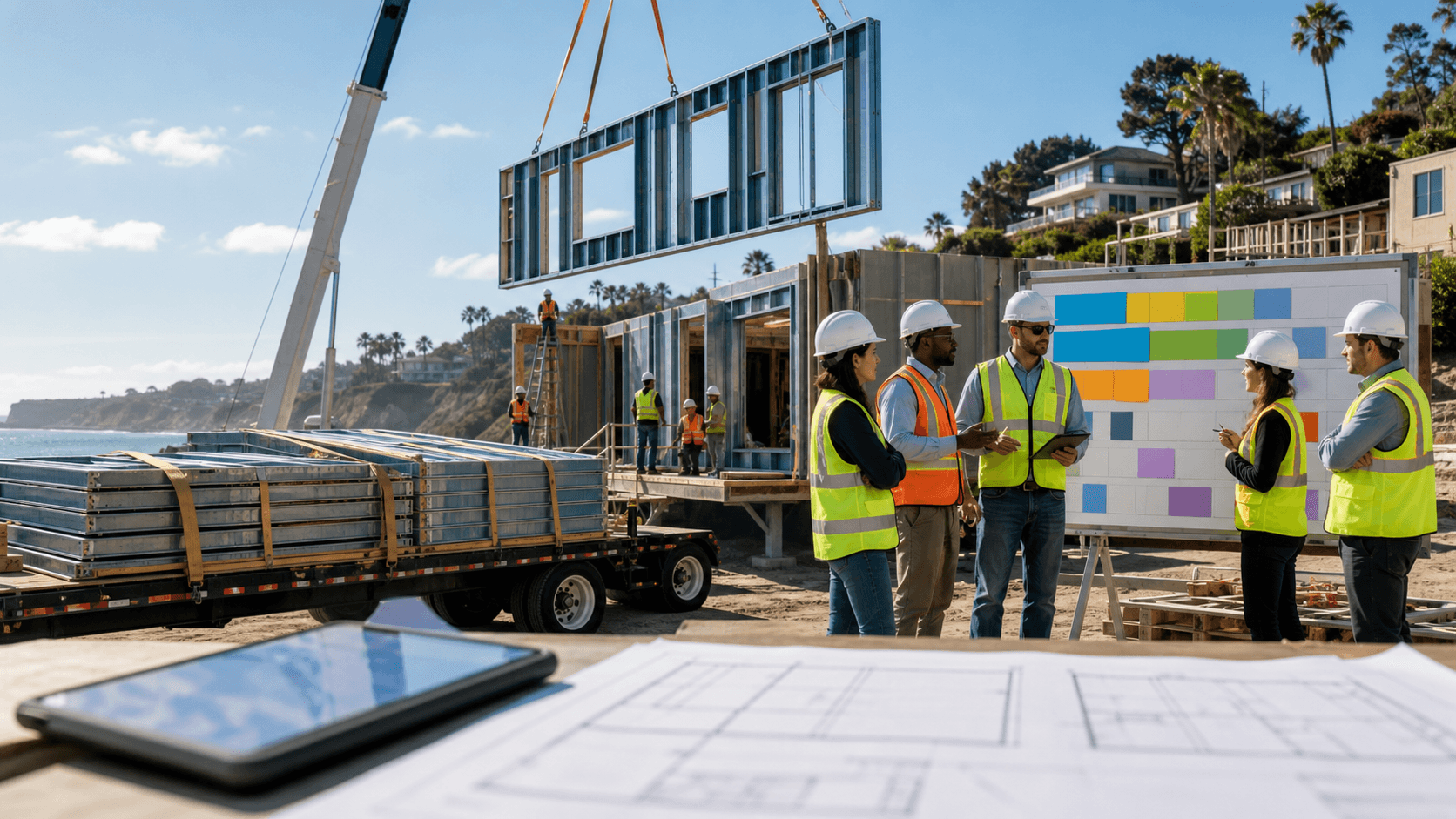
Plan Your California Build Around a Smarter Schedule
Modular construction scheduling is really about one thing: knowing what happens when, and who is responsible at each step. For California sites, that clarity is worth a lot. Tight lots, busy cities, fire zones, and tricky utilities can all slow a project down if the schedule is not planned around real local conditions.
Traditional construction in California often relies on hope rather than a solid plan. Timelines stretch because of:
- Permitting backlogs at local agencies
- Labor shortages and trade conflicts
- Weather and site access issues, especially on complex sites
- Inspection delays when inspectors are overbooked
Our goal at Fast Struct is to bring more predictability to that process. We are a Silicon Valley-based, technology-driven factory and licensed contractor that designs, engineers, and manufactures a precision-engineered light-gauge steel system for California sites. We connect digital design, U.S.-made steel manufacturing, and on-site construction so your schedule does not depend on one slow step at a time.
We also do not believe in a one-size-fits-all approach. For each project, we choose modular, panelized, or hybrid delivery based on your site, your design, and your target dates. Late spring is a smart time to lock this in. Many teams want to break ground as days get longer, and a clear scheduling plan now can keep work moving smoothly through the busy summer and into the end of the year.
How Factory-Built Scheduling Really Works in California
In simple terms, factory-built scheduling (for modular, panelized, and hybrid projects) means your project moves on parallel paths. While the factory builds your structure, the site is prepared at the same time. Instead of waiting for one trade to finish before the next starts, multiple tracks move forward together.
A key part is understanding who reviews what in California:
- HCD or HCD-approved agencies review and inspect the factory-built components that are manufactured off-site.
- Local jurisdictions review and inspect everything that is site-specific, such as foundations, installation, utilities, grading, zoning, and any other items outside the approved factory-built scope.
As both an HCD-licensed manufacturer and a licensed contractor, we coordinate these pieces under one roof. That means one team plans:
- Factory engineering and fabrication milestones
- HCD or HCD-approved inspections in the factory
- Local inspections for foundation, utilities, grading, and installation
Once permits are approved, many projects can move from the start of fabrication to substantial completion within roughly 3 to 5 months. The exact time depends on:
- Site access and terrain
- Utility coordination with local agencies
- Jurisdictional review timing
- Total project scope and finish level
Compared to traditional framing and trade-by-trade sequencing, this integrated scheduling approach is typically faster and more predictable, because less work is waiting in line.
Choosing Modular, Panelized, or Hybrid for Your Schedule
One of the most important scheduling decisions is how the building itself is delivered. We work with three primary paths, each with its own strengths.
Modular delivery focuses on faster delivery of more finished 3D volumes:
- Units are built as three-dimensional sections in the factory.
- Depending on the project type, modular units can arrive substantially complete inside.
- Best when the site can accept larger pieces and the design fits this format.
Panelized delivery focuses on flexibility and access:
- We manufacture precision-engineered light-gauge steel wall, floor, and roof systems.
- These panels ship flat, then are assembled on site for greater flexibility.
- A good fit for tight infill lots, custom layouts, or areas with limited crane reach.
Hybrid delivery is a best-fit mix of both:
- Some parts of the building might be full, substantially finished modular volumes.
- Other areas might be panelized wall, floor, and roof systems for more design freedom.
- We match each component to site limits, design needs, and schedule demands to select the best-fit delivery method.
The distinction is simple:
- Modular equals fully or substantially finished 3D volumes from the factory.
- Panelized equals flat light-gauge steel wall, floor, and roof assemblies that are put together on site.
- Hybrid equals a project that uses both fully finished modular volumes and panelized systems in one coordinated design.
Our core differentiator is that we do not push one method. We study your California site, your jurisdiction, and your goals, then recommend modular, panelized, or hybrid delivery based on what actually supports the right schedule and overall project performance, instead of a one-size-fits-all solution.
Inside Our Precision-Engineered Light-Gauge Steel Workflow
A predictable schedule starts with a clean digital workflow. We connect design, engineering, and manufacturing from the very beginning.
Here is how that looks in our system:
- Architects, developers, builders, and owners work with us to align design with factory production.
- Once plans are approved, we convert them into production-ready digital files.
- Those files feed directly into our high-tech steel framing machines.
We use U.S.-made, high-quality light-gauge steel. Each piece is cut and formed with factory precision, which supports:
- Better dimensional stability over time.
- A non-combustible structure suited for fire-sensitive regions.
- No rot, warp, or shrink the way wood can move.
- Cleaner assembly and reduced rework in the field.
Because the structure does not twist or shift, on-site assembly is cleaner. That usually means fewer surprises, fewer adjustments, and less rework that could slow down the schedule.
Every assembly goes through factory QA before it reaches your site. This precision-engineered light-gauge steel system supports tighter sequence planning, since we can predict how components will fit together for modular, panelized, and hybrid projects. For California fire risk, seismic demands, and tight skilled labor, a U.S.-made steel, factory-driven workflow is often a better fit than traditional field framing.
Coordinating Site Work, Deliveries, and Inspections
While the factory is busy, the site cannot sit still. Parallel path scheduling means we are planning both sides of the work at once.
After permit approval, typical phases include:
- Foundation and underground utilities, sequenced to match the fabrication schedule.
- Grading and access improvements so cranes or material handlers can reach the set area.
- Coordination with neighbors and local rules for street closures or staging areas.
When deliveries begin, we plan:
- Delivery windows that fit local traffic and community needs.
- Crane or other equipment sized for the site.
- Staging and assembly areas that keep the site organized.
Depending on the project type, modular units can arrive substantially complete and be set in place, while panelized systems are assembled on site for greater flexibility, followed by trade finish work where needed.
Inspection touchpoints stay clear:
- HCD or HCD-approved inspections happen in the factory for the off-site components.
- Local inspectors focus on foundations, connections, utility tie-ins, grading, zoning, and any other local scope items outside the factory-built approval.
From the start of fabrication to substantial completion, many projects finish in about 3 to 5 months post-permit, depending on how complex the site and scope are. The goal is not to rush, but to keep work flowing without long gaps of idle time.
Why Our Licensing and One Team Model Matter
Licensing shapes how clean your schedule can be. We hold a rare combination of approvals: we are a state-approved, HCD-licensed home manufacturer, a general contractor, and we hold commercial licensing as well. That mix allows us to support a wide range of residential and mixed-use projects under one coordinated team.
For scheduling, this matters because there are fewer handoffs. One accountable group can:
- Plan the full sequence from digital design through factory production and on-site installation.
- Keep design intent aligned with engineering and field conditions.
- Coordinate fabrication, inspections, and trades to match real-world milestones.
- Help architects, developers, builders, and owners see a clearer path for cash flow and phasing.
From start to finish, you work with one integrated Fast Struct team, with design, engineering, manufacturing, and construction all connected through a single precision-engineered light-gauge steel system and digital workflow.
For us, speed is only part of the point. The real win is schedule certainty and quality, backed by a precision-engineered light-gauge steel system and an integrated delivery model that stays with you from the first digital file to the final punch list.
Get Started With Your Project Today
If you are ready to bring predictability and control to your offsite builds, our modular construction scheduling approach is built to support your team from planning through delivery. At Fast Struct, we partner with you to streamline timelines, align stakeholders, and reduce costly surprises. Tell us about your upcoming project, and we will walk you through how our system can support your goals. If you have questions or need a custom approach, simply contact us, and we will respond quickly.


