
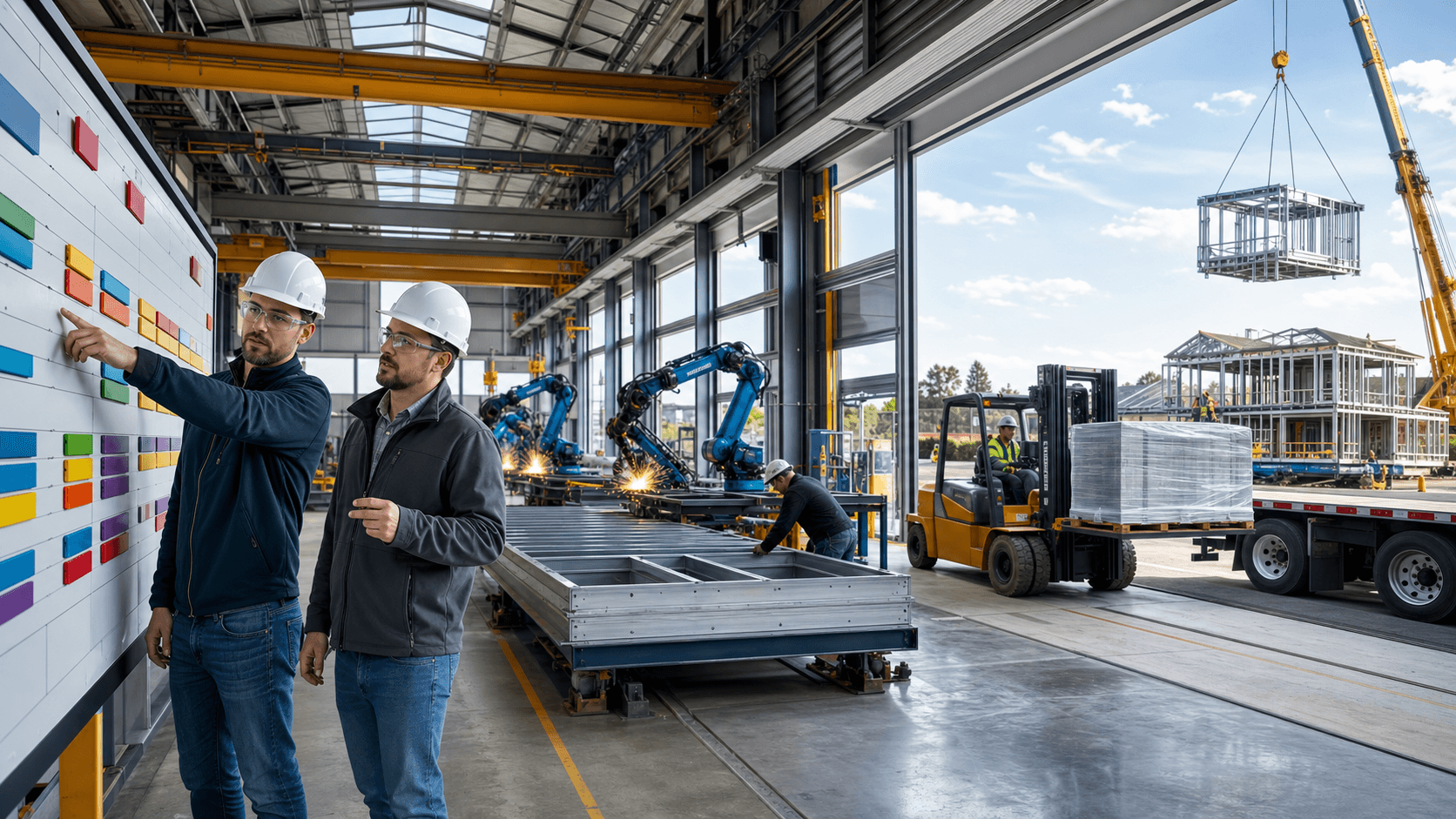
Modular Construction Scheduling for Hybrid Steel Homes
Modular construction scheduling comes down to one simple promise: knowing when your project will be completed and being able to trust that timeline. In California, where summer building seasons fill up fast and cities get busy, a clear schedule can matter just as much as the floor plan. Owners, developers, architects, and builders all want the same thing: a plan that keeps design, permits, factory work, and site work moving without chaos.
In this article, we will walk through how modular construction scheduling works for light-gauge steel hybrid homes, why picking the right mix of modular, panelized, and site-built work is your strongest tool, and how a technology-driven factory approach helps keep your calendar in control. We will also talk about how permitting and inspections fit into the picture so you can see the full path from design to move-in.
At Fast Struct, we use a precision-engineered light-gauge steel system and we are based in Silicon Valley, so we see tight California schedules every day. One-size-fits-all modular does not always fit local lots, steep slopes, or busy streets. Matching the method to the project is what keeps timelines realistic and predictable, instead of guessing and hoping.
How Modular Construction Scheduling Really Works
Think of modular construction scheduling as two tracks running at the same time. On one track, the site is getting ready with grading, foundations, and utilities. On the other track, the factory is fabricating your light-gauge steel modules or panels. The schedule is about lining up those tracks so they meet at the right time.
Typical phases usually include:
- Preconstruction: design, engineering, and budgeting
- Permitting: city, county, or other local approvals
- Factory fabrication: steel framing, assembly, and interior work as planned
- Delivery: transport of modules or panels to the site
- On-site assembly and finish: stacking or standing units, then completing finishes
The big shift with modular construction scheduling is that factory work does not wait for all on-site work to finish. Once permits are approved, many hybrid steel projects can move from fabrication to completion in about three to five months, depending on site conditions, trade availability, utility coordination, and local inspection timing. This is typically significantly faster than traditional construction timelines.
What actually sets your move-in date?
- Level of factory completion planned for your project
- Number of modules or panels and their size
- Complexity of finishes and details
- How your local inspectors schedule site visits
When those pieces are thought through early, the calendar drives the decisions instead of last-minute changes driving the calendar.
Modular, Panelized, and Hybrid Steel Delivery
Modular delivery means light-gauge steel 3D volumes built in the factory. These are box-like units that can arrive substantially complete, depending on your project type and design choices. They often include structure, exterior walls, and a good portion of interior work before they ever reach your property.
Panelized delivery is different. Here, the factory creates flat light-gauge steel wall, floor, and roof assemblies. Those panels ship more compactly and are then assembled into the full structure on site. Panelized systems:
- Allow more architectural flexibility
- Work well on tight urban lots or flag lots
- Help with custom layouts that do not repeat from unit to unit
Hybrid delivery is where things get interesting. Instead of forcing a project into only modular or only panelized, we combine both as needed for each California site. For example, we might use modular units for repeating bedroom stacks and panelized assemblies for a unique living area that fits around trees, slopes, or property lines.
This choice directly affects scheduling. With a hybrid approach, we can:
- Shorten critical path items by using modular where speed matters most
- Reduce on-site complexity by moving repeated work into the factory
- Keep flexibility for tricky corners, tight streets, or one-of-a-kind features
A rigid, single-method system cannot do that as well, which can lead to slowdowns when the site does not match the boxes.
Why Hybrid Scheduling Wins in California Conditions
California projects deal with narrow infill lots, steep hillside sites, wildfire zones, seismic rules, and dense city streets. Each of these conditions changes how modular construction scheduling should be planned.
Hybrid sequencing gives us more levers to pull:
- Use volumetric modular where there is good crane access and repeating layouts, so we can enclose space quickly
- Use panelized systems where large modules cannot turn corners, pass wires, or clear trees and power lines
- Reserve site-built work for the limited pieces that simply cannot be factory-built
Our precision-engineered light-gauge steel system supports this approach. The structure is made from U.S.-made, non-combustible steel that does not rot, warp, or shrink. That means better dimensional stability and fewer framing surprises that can slow down trades on site.
Cleaner assemblies, accurate geometry, and strong seismic connections mean:
- Less rework for follow-on trades
- Fewer "field fixes" when finishes do not align
- A smoother path to on-time inspections and completion
In wildfire and seismic areas, the combination of non-combustible structure and consistent factory fabrication is especially helpful for long-term performance as well as schedule reliability.
High-Tech Steel Manufacturing and Approvals That Protect Your Schedule
Behind hybrid scheduling is a digital workflow that ties design, engineering, and manufacturing together. Architectural and engineering plans are translated into production-ready files that feed directly into automated light-gauge steel framing machines. This connects the design, engineering, and manufacturing process and cuts down on miscommunication between office and factory.
In the factory, steel is cut, punched, and formed to tight tolerances, then assembled into modules or panels. Each assembly goes through structured quality checks before leaving the plant. For scheduling, this means:
- Fewer field surprises that could hold up inspections
- Cleaner fit for windows, doors, and finishes
- More predictable sequencing for trades like plumbing, electrical, and HVAC
Approvals are split between factory and site. HCD or HCD-approved agencies review and inspect the factory-built components manufactured off-site. Local jurisdictions still handle foundations, installation, utilities, grading, zoning, and all work outside the factory-built scope. When everyone understands this split, project calendars are easier to plan, with fewer last-minute inspection surprises.
Fast Struct operates as both a licensed contractor and a state-approved, HCD-licensed manufacturer. This combination of manufacturing, general contracting, and commercial licensing helps keep projects coordinated under one team. That "one team" structure means design, engineering, manufacturing, and field crews are coordinated under a single umbrella, which is a big help for staying aligned with the schedule from first sketch through final inspection.
Planning Your Next Hybrid Steel Project
The real strength of modular construction scheduling is not about choosing modular over traditional building in a blanket way. It is about finding the right blend of modular, panelized, and site-built work for each specific California property. Hybrid steel delivery lets owners, developers, architects, and builders tune the schedule to the lot, not the other way around.
When Fast Struct is involved early in feasibility and schematic design, we can test different hybrid mixes, look at crane access, think through inspection steps, and set realistic targets, often in the three-to-five-month range after permits are in hand, depending on conditions. From there, our integrated, one-team model carries projects from design and engineering through HCD approvals, factory fabrication, and on-site installation, providing A-to-Z support with a single focus: speed, quality, and predictability for your light-gauge steel project.
Get Started With Your Project Today
If you are ready to bring predictability and clarity to your build timeline, our modular construction scheduling framework is designed to keep every phase on track. At Fast Struct, we work with your team to translate complex project requirements into a clear, actionable schedule. Share your upcoming project details so we can help you streamline coordination, reduce delays, and improve budget control. Have questions about how this would fit your next project? Just contact us and we will walk you through the next steps.


